
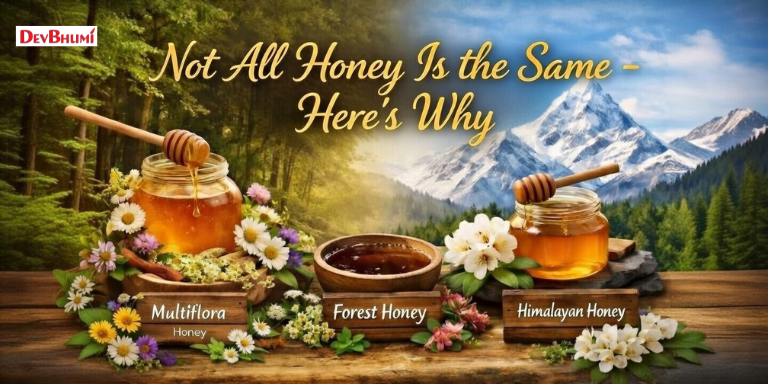
How Different Flowers Change Honey’s Taste & Health Benefits
-
By: admin
- January 14, 2026
Not All Honey Is the Same – Here’s Why
When you open a jar of honey, you aren’t just looking at a sweetener. You are looking at a “liquid map” of a specific time and place. Most of us grew up thinking honey is just that golden, translucent liquid from the supermarket. But if you’ve ever tasted honey straight from a forest hive or a Himalayan valley, you know that honey has personalities.
Its taste, color, thickness, and even its “healing power” depend entirely on the flowers the bees visited. This is known as the floral source. Let’s dive deep into why the flower matters and how you can choose the best honey for your home.
What Exactly is a “Floral Source”?
Think of a bee like a tiny chef. The nectar it collects is the raw ingredient. Just as the taste of your food depends on whether you use fresh herbs or dried spices, honey’s quality depends on the flowers available to the bees.
- Mustard Fields: Give us light, creamy honey that crystallizes quickly.
- Wild Forest Blooms: Give us dark, intense honey with herbal notes.
- Himalayan Herbs: Give us “medicine in a jar”—rich, thick, and potent.
Every flower adds its own unique natural compounds, enzymes, and antioxidants. When you change the flower, you change the honey’s DNA.
1. Multiflora vs. Single-Flower Honey: Which One Wins?
In the world of honey, there are two main types of “harvesting styles.”
Multiflora Honey (The “All-Rounder”)
Multiflora honey is what happens when bees are allowed to roam free in a diverse environment. They might visit a bit of Neem, some Tulsi, a few wild berries, and seasonal wildflowers all in one trip.
- The Experience: Because it’s a mix, the taste is balanced and “complete.” It’s usually darker and changes slightly in flavor every season.
- Why it’s a Superfood: It is like a natural multi-vitamin. Because it contains nectar and pollen from dozens of plants, it offers a wider range of antioxidants. It’s the best choice for building daily immunity and helping with seasonal allergies.
Single-Flower Honey (The “Specialist”)
Also known as Monofloral honey, this is produced when beekeepers place hives in a large area dominated by one plant, like a Litchi orchard or a Eucalyptus grove.
- The Experience: It has a very distinct, predictable taste. Eucalyptus honey tastes slightly medicinal, while Litchi honey has a beautiful fruity aroma.
- When to use it: These are great for specific needs. If you have a stubborn cough, Eucalyptus honey is your best friend. If you want a light sweetener for your tea that doesn’t overpower the flavor, Litchi or Acacia honey is perfect.
2. Why Forest Honey Tastes Stronger (and Better)
Many people try Forest Honey for the first time and think, “Wait, why is this slightly bitter? Why is it so dark?”
In the city, we are used to “sugar-sweet” things. But true forest honey is bold. It’s the difference between a sugary soda and a rich, dark roasted coffee. Here is why it’s so intense:
- Medicinal Wildflowers: Forests are home to plants like Neem, Jamun, and various wild herbs. These plants have strong medicinal properties which carry over into the nectar.
- No Shortcuts for Bees: In deep forests, there is no “sugar-feeding.” Bees survive 100% on wild nectar, making the honey dense and enzymatically rich.
- Mineral Wealth: The darker the honey, the higher the mineral content (like iron and magnesium). This gives it a “strong” punch that hits the back of your throat—a sign of pure, unadulterated power.
3. Himalayan Honey vs. Plain-Area Honey: High Altitude Power
Geography changes everything. A bee working in the cold, thin air of the Himalayas behaves differently than a bee in the flat plains of a farm.
The Himalayan Advantage
Himalayan honey (from places like Uttarakhand or Himachal) is often considered the gold standard. Why? Because the plants there are “stressed” by the cold and UV radiation. To survive, these plants produce much higher levels of protective compounds. When bees collect this nectar, they are essentially collecting high-altitude medicine.
- Texture: It is naturally thick and has a deep amber color.
- Crystallization: Because it is raw and rich in natural pollen, it will almost certainly freeze or “crystallize” in winter. This is a mark of purity, not a sign of added sugar.
Plain-Area Honey
Honey from the plains usually comes from commercial crops like Mustard or Sunflower.
- The Pros: It’s mild, easy to pour, and great for kids.
- The Cons: Large-scale farming in the plains often involves pesticides. Also, if the honey is mass-produced, it might be “ultra-filtered,” which removes the healthy pollen just to make it look clear and pretty.
How to Choose: The Quick Reference Guide
| Your Goal | Recommended Honey | Why? |
| Daily Immunity | Multiflora Forest Honey | Diverse nutrients from many plants. |
| Cough & Cold | Forest or Eucalyptus | Natural antibacterial and soothing oils. |
| Kids & Baking | Litchi or Multiflora (Plain) | Mild, sweet, and not overpowering. |
| Stamina & Recovery | Raw Himalayan Honey | High enzyme count and mineral-rich. |
| Skin Care/Masks | Acacia or Single-Flower | Consistent texture and high purity. |
Important Truths: Don’t Let Marketing Fool You
Before you buy your next jar, keep these two things in mind:
- Dark Honey is NOT Impure: In fact, darker honey usually has more antioxidants than light, clear honey.
- Crystallization is GOOD: Real, raw honey will turn into a creamy solid when it gets cold. If your honey stays perfectly liquid in a freezing fridge, it has likely been over-heated or processed with corn syrup.
Final Thoughts
Honey is a living food. It’s a gift from the bees that captures the essence of the flowers they touched. If you want the most “bang for your buck” in terms of health, reach for Raw Forest or Himalayan Multiflora honey. It might taste a little different than the commercial syrup you’re used to, but your body will recognize the difference immediately.
Choose honey that is raw, unfiltered, and ethically sourced. Your health (and the bees) will thank you.
Frequently Asked Questions (FAQs)
Why is some honey darker than others?
The color depends on the minerals and antioxidants in the nectar. Honey from trees and forests is usually darker, while honey from flowers like clover or litchi is lighter.
Is it safe to eat honey that has turned solid?
Absolutely! This is called crystallization. Just place the jar in a bowl of warm water (not boiling), and it will return to its liquid state without losing its benefits.
Does forest honey expire?
Pure, raw honey never truly expires if kept in a sealed jar. However, its aroma and medicinal enzymes are best within 2-3 years of harvest.
Why does Himalayan honey cost more?
Harvesting in the mountains is difficult and dangerous. Plus, the flowering season is shorter, and the nectar is more concentrated and medicinal.
Can I give forest honey to my toddler?
Honey (of any kind) is generally safe for children over 1 year old. For younger kids, forest honey might be a bit too “strong” in taste, so start with a mild multiflora.
We want to give you 10% discount for your first order,
Use discount code at checkout

We want to give you 10% discount for your first order,
Use discount code at checkout
Written by
admin
The author has not added a bio yet.