
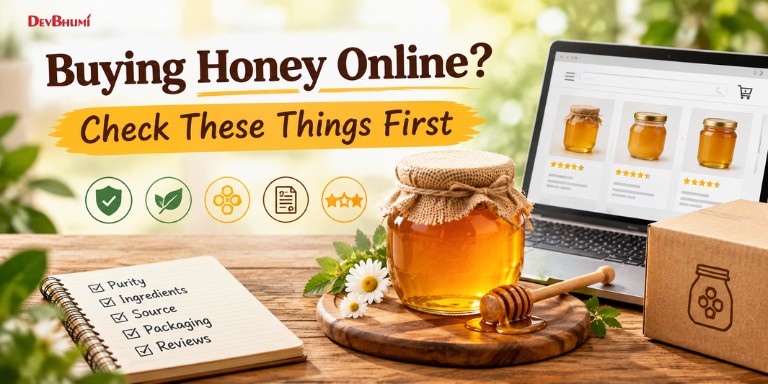
Buying Honey Online? Here’s What You Need to Know First
-
By: admin
- September 4, 2026
What to Look for When Buying Honey Online
Shopping for honey online is easy enough. You do your research, compare different products, read the reviews and order your honey. However, when it comes to foods you consume on a daily basis, picking the cheapest or the prettiest one might not be the best choice.
From the quality of the honey to its ingredients, sources, certification, packaging, and customer reviews, there are numerous things that can reveal if an online honey product is good for purchase. With the growing number of companies offering “pure”, “natural” or “raw” honey products, it’s important to know what to look out for when purchasing your online honey.
If you’re looking to buy pure honey, raw honey, organic honey or just a good one in general, here’s what to look out for first.
Why Is It Important to Check Honey Before Buying Online?
While buying a product in a brick-and-mortar store, you have the chance to view it and examine it visually. When you shop online, you do not have this opportunity because you rely solely on the product description, label information, images, and reviews of the product.
It is crucial that you carry out some research before buying the honey.
Before you buy it, try to find out what the jar contains and where it is from.
1. Read the Ingredient List Carefully
The ingredient list is something you should look into right away while making an online purchase of honey.
It is preferable to get a brief explanation of what is in the jar from the product description.
Pure honey does not require a lengthy ingredient list containing unneeded items.
Look for the following:
- Honey as the primary or only ingredient: It makes it much easier to know what exactly you are getting.
- Unneeded added ingredients: Be wary of unnecessary sweeteners, syrups, flavors, and any other additional ingredients in your product.
- Product information: Good brands tend to give clear information about their ingredients and product characteristics.
- Information on variety: For example, what is floral, forest, multifloral, or another variety.
2. Check the Source and Origin of the Honey
The kind of flowers and plants that bees use to extract nectar is important in the composition of honey. Thus, the knowledge of the origins of the honey can be quite helpful in determining some information on the honey being considered.
An acceptable listing on the internet is expected to provide some information on the origin of the honey, and not just use vague statements like “100% natural.”
Before ordering, check:
- The geographical origin of the honey.
- The floral or botanical source, if mentioned.
- Information about the beekeeper or producer.
- Whether the brand explains its sourcing process.
- Whether the product has traceability information.
Transparent sourcing can give you greater confidence in the product you are purchasing.
3. Look for Certifications and Quality Information
Certifications and quality information may help you distinguish between promotional claims and facts regarding the products.
Depending on what kind of product you are looking at and where it was purchased, see if there are any food safety or quality certifications by the brand.
Check out:
- Details about the food safety license or registration of the product: It may show that the seller works under the food-related regulations.
- Information about testing: Some manufacturers include lab testing or quality parameters in their descriptions.
- Organic certification: In the case of organic products, you should look for certification instead of the word “organic.”
- Batch number: Batch numbers can help with product traceability.
Please keep in mind that a certification itself will not tell you anything about the taste and quality of the product, but it is one of the aspects of evaluation.
4. Don’t Choose Honey Only Because It Is Cheap
While cost is an essential factor to consider, being the least expensive shouldn’t make it your automatic choice.
The production, processing, testing, packaging, and shipping of honey require costs. It’s worth looking into any very cheap products, especially when such a product boasts high-quality attributes.
Rather than asking, “Which honey is the cheapest?” consider the following criteria:
- Amount available in a bottle.
- Composition and information about the product.
- Origin of the product.
- Information about testing or certification.
- Company reputation.
- Reviews.
- Packaging and shipping conditions.
An only slightly more expensive product can provide you with much more information.
5. Read Customer Reviews – But Read Them Cleverly
Reviews are an excellent way to gain insight into what other customers have experienced, but do not base your decision solely on their star rating.
It is quite impressive to find products that have several thousand reviews, but each review gives a good insight.
Some things to look out for while reading reviews are:
- Taste and smell.
- Quality of packaging.
- Leakage and damage to the jar.
- Texture and appearance.
- Delivery experience.
- If the product was as described online.
- Purchase experience.
Also, try to read reviews from the recent past. They give better information about the present quality and packaging of the product.
6. Examine the Product Label and Expiry Information
Whenever you are purchasing foods via the internet, always ensure that you have all necessary information on the product label. Ideally, there should be some details that will help you understand the product you are purchasing.
Some of these details include:
- Quantity of the product.
- Details of manufacture/packaging.
- Information on the best before date/expiry date.
- Batch/Lot number.
- Storage details.
- Details of the manufacturer/market.
- Customer care details.
If necessary information is not provided by the product, then select another supplier.
7. Understand the Difference Between “Raw,” “Natural,” and “Organic”
While these terms get tossed around a lot in honey marketing, they do not always mean the same thing.
The term “natural” could refer to the positioning of the product, whereas “raw” refers more to the processing of the honey. “Organic” means a whole different set of regulations when applicable.
Do your research before purchasing and look at what the company itself has to say about their product instead of just believing a certain word means better quality.
8. Check the Seller, Not Just the Brand
Buyers might be overly concerned with the brand of the honey they are buying and forget about the seller altogether.
When buying from a virtual marketplace, consider:
- Ratings and feedback about the seller.
- Replacement policy of the seller.
- Information regarding authenticity of the product.
- Shipping methods.
- Whether the seller offers all the information about the product.
A good seller makes the entire online shopping process much easier.
9. Pay Attention to Packaging and Storage
Honey stores pretty well, however packing is also important because the right packing will protect your product from any damage during shipping and storage.
Here are the things to look out for when examining online descriptions:
- Proper food grade packing.
- Properly sealed packaging.
- Shipping-safe packing.
- Storage instructions.
- Packing which will protect the item from damage during shipping.
It’s also important to note that honey may crystallize over time. Honey crystallizing doesn’t necessarily mean that it has gone bad. It may just have a different texture due to the type of honey and storing conditions.
10. Don’t Fall for Every “Purity Test” Online
You might find social media posts that promise that certain easy experiments done at home will be able to test the purity of the honey. However, such viral tests may mislead you.
The look, consistency, and reaction in an experiment conducted at home alone will not be able to conclusively determine the purity of the honey.
Rather, you need to depend upon:
- Proper product labelling.
- Reputable sellers.
- Transparent sourcing.
- Relevant certifications.
- Reliable testing information.
- Consistent customer feedback.
When purchasing food online, evidence is more useful than viral hacks.
A Quick Checklist Before You Click “Buy Now”
Not sure which honey you should buy? Here is a quick checklist before you finalize your purchase.
✔ Check the ingredients list.
✔ Source and origin verification.
✔ Check for any certifications.
✔ Quantity and price comparison.
✔ Recent customer reviews.
✔ Check batch and best-before details.
✔ Clarify claim terms such as “raw,” “natural,” and “organic.”
✔ Verify the seller’s details.
✔ Check packaging details.
✔ Do not trust viral at-home tests.
Why Choose Devbhumi Honey?
There are some factors that should be considered when choosing honey on the web. These factors include provenance, purity, openness, and community involvement. Devbhumi Honey combines all these factors as it sources its honey from the Himalayan area of Uttarakhand. As per Devbhumi, the varieties of their honey are Raw Organic Honey, Pahadi Honey, Organic Honey, and flavored honey like Acacia, Jamun, Litchi, and Kesar.
Devbhumi Honey is special because it adopts a producer-led business model. Devbhumi says that they work with producers in Uttarakhand and they try to serve rural communities in a sustainable way.
If you want to buy honey online, Devbhumi is one of the choices.
Final Thoughts!
Purchasing honey on the Internet doesn’t have to be difficult. It all comes down to becoming a more intelligent consumer of information about the products’ labels, descriptions, reviews, and sellers.
Instead of buying a bottle simply due to its appealing appearance or affordability, spend some time researching what’s inside it, where it came from, what kind of certifications it has, reviews, labeling, and packaging.
Next time when you are trying to find some pure honey on the Internet, ask not only “Which one should I choose?” but rather “What kind of evidence does this brand have to prove that it is worthy of my trust?”
This simple question may turn out to be an eye-opening experience.
Frequently Asked Questions!
1. What do I need to look out for when purchasing honey online?
The ingredients, origin, certifications, seller’s identity, reviews, quantity, packaging, and the best before date should all be taken into account while purchasing honey online.
2. How do I get pure honey online?
Ingredients, sourcing, relevant certifications, proper labeling, and a reputable seller should all be considered. Avoid using marketing terms like “100% pure” alone as the sole criteria.
3. Does crystallization mean the honey is spoiled?
No. It is perfectly normal for honey to crystallize over time. Crystallization does not necessarily indicate spoilage. The texture may differ based on the honey’s floral origin.
4. Should I rely on the customer reviews only when making an online purchase of honey?
Yes and no. Customer reviews are certainly helpful but shouldn’t be your only criteria. Reviews can be combined with other factors such as ingredients, sourcing, certifications, and labeling.
5. Is expensive honey always better?
This is not necessarily so. An expensive price tag does not guarantee quality automatically. It is best to compare various factors about the honey product including its ingredients, sourcing, testing details, certifications, and quantity.
6. What is the best method to test honey quality?
The best method to test honey quality is by evaluating product information, labeling, sourcing, certification, and quality testing information.
We want to give you 10% discount for your first order,
Use discount code at checkout

We want to give you 10% discount for your first order,
Use discount code at checkout
Written by
admin
The author has not added a bio yet.