
How Honey Is Made: From Flower to Your Kitchen Jar
-
By: admin
- December 6, 2025
The Magical Journey of Nature’s Purest Sweetener
Honey is one of the most natural and untouched foods on Earth. Long before it reaches your kitchen jar, honey goes through a fascinating journey—beginning with a tiny bee visiting a flower and ending with a golden, nutrient-rich liquid ready to boost your health.
This article explains how honey is really made, step-by-step, and why pure, organic honey like Devbhumi Honey is so special.
Step 1: Nectar Collection – The First Drop of Magic
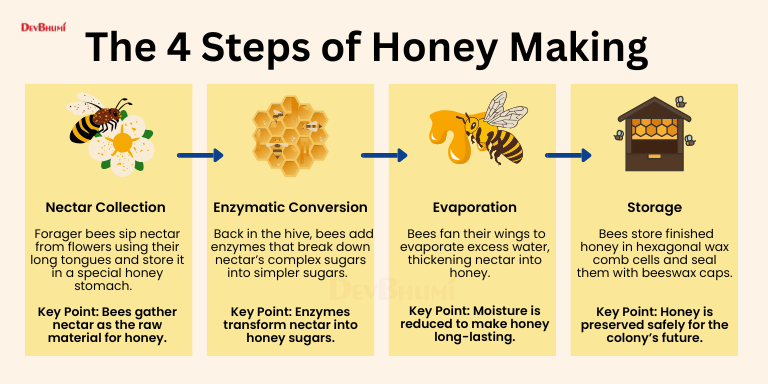
Honey begins when worker bees fly from flower to flower collecting nectar, a sweet liquid found deep inside blossoms.
Each bee visits 50–100 flowers per trip, storing nectar in a special honey stomach, separate from their normal stomach.
During this time, bees also collect pollen, which adds natural nutrients and flavors to the honey.
Step 2: Nectar Transformation – Inside the Bee’s Honey Stomach
Inside the honey stomach, the nectar mixes with natural enzymes like invertase.
These enzymes begin turning nectar’s complex sugars into simpler sugars—making it easier to digest and preventing spoilage.
This is the first stage of honey formation.
Step 3: Back to the Hive – Passing Nectar to Other Bees
When the worker bee reaches the hive, she passes the nectar mouth-to-mouth to house bees.
This chain continues until the nectar becomes thicker and partially dehydrated.
This teamwork is what makes bees some of the world’s best natural chemists.
Step 4: Honeycomb Storage & Fan Drying
House bees store the processed nectar into hexagonal honeycomb cells made of beeswax.
Then, hundreds of bees fan their wings to evaporate water from the nectar.
This reduces moisture to about 17–20%, turning runny nectar into thick, long-lasting honey.
Step 5: Capping the Honey – Nature’s Seal of Purity
Once the honey reaches perfect thickness, bees seal the honeycomb cell with a thin layer of wax.
This process is called capping.
Capped honey can stay fresh for years without spoiling—a miracle only nature can create.
Step 6: Harvesting the Honey – From Hive to Human Hands
Beekeepers gently remove honey-filled frames from the hive.
A thin layer of wax is cut off, and the frames are placed in an extractor, which spins them to release honey using centrifugal force.
This honey is then filtered to remove wax bits—but not heated, not refined, and not processed in the case of pure, organic honey.
Step 7: Bottling – Into Your Kitchen Jar
The final raw honey is poured into clean jars—ready for your home.
Pure honey contains:
- Natural enzymes
- Antioxidants
- Vitamins
- Minerals
- Pollen
This is why raw honey is healthier than commercial, processed honey.
Why Devbhumi Honey Is Special ?
Because it’s:
✔ 100% raw & unprocessed
✔ Collected from clean Himalayan forests
✔ Free from chemicals, antibiotics, and additives
✔ Harvested with ethical beekeeping practices
The journey from flower to jar remains pure and untouched.
FAQs
Does honey come from nectar or pollen?
Honey is made from nectar, but bees also collect pollen, which enhances the nutrition and flavor of honey.
How long does it take bees to make honey?
It can take weeks to months, depending on the season and flower availability. A single bee produces only 1/12th of a teaspoon in its lifetime.
Why does honey crystallize?
Because raw honey contains natural glucose. Crystallization is a sign of purity, not adulteration.
Do bees die when honey is harvested?
No. Ethical beekeepers ensure bees have enough honey left to survive. Good brands never harm their bees.
Is raw honey better than processed honey?
Yes. Raw honey retains enzymes, antioxidants, and nutrients that get destroyed when heated or overly filtered.
We want to give you 10% discount for your first order,
Use discount code at checkout

We want to give you 10% discount for your first order,
Use discount code at checkout
Written by
admin
The author has not added a bio yet.