
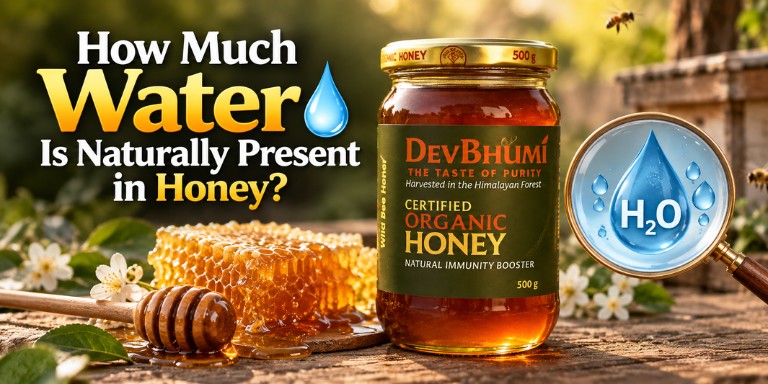
How Much Water Is Naturally Present in Honey?
-
By: admin
- September 18, 2026
People often think about honey as only an absolutely naturally sweet and thick golden liquid. However, honey consists of not one ingredient only, as there is another one which makes it a perfect product for everyone who loves it.
There is a surprising fact about honey which will shock you. Honey contains water. So, how much is the amount of water that honey consists of?
Does it influence its quality, taste, texture, storage period or anything else? And does natural water presence mean that honey is somehow diluted?
To be honest, most honeys naturally contain about 13%-20% water, while most of them have about 17%. However, there are some factors which may influence this number.
Let’s understand what honey’s water content really means and why it matters.
How Much Water Is Naturally Present in Honey?
Honey consists mainly of sugars (fructose, glucose), water, organic acids, enzymes, minerals, and other substances.
Natural moisture content of honey is usually about 17%, although there might be some variation. Scientific literature provides values for moisture content of honey from about 13% to 25% depending on different conditions.
For example, a normal serving of 100 grams of honey is composed of approximately 17 grams of water with the remainder of the weight coming mainly from carbohydrates and some minor components. The nutrition facts available from the United States Department of Agriculture show that there are 17.1 grams of water in each 100 grams of honey.
This makes honey not entirely devoid of water—but that is not necessary.
Why Does Honey Naturally Contain Water?
Most of the water found in honey is derived from the nectar gathered by the bees. Nectar from flowers naturally has a certain amount of moisture in it. Then, the bees use a natural process to convert the nectar into honey.
Through this process, bees work towards reducing the moisture in the nectar as they gather and process it. Honey then becomes thick and concentrated due to the removal of excess moisture.
This natural dehydrating process is a key factor behind the formation of honey’s thick consistency.
A number of things affect the amount of moisture present in the final product.
- Flowers: Various flowers yield nectar with different water levels.
- Weather: Factors like temperature and humidity influence the nectar and the water levels in the honey.
- Maturation: If the honey has matured enough in the hive, then there will be low levels of moisture in the honey.
- Harvesting time: If the honey is harvested before maturing, then there will be high levels of moisture in the honey.
- Storage: Since honey is hygroscopic, it absorbs moisture from the atmosphere.
Is Water Content a Sign of Honey Quality?
Humidity in honey is one of the important properties used to assess the quality of honey. However, it is impossible to estimate the humidity of honey without considering other aspects as well.
International standards for honey include regulations regarding moisture content in honey, because excessive moisture can lead to the instability of this product. For instance, according to the Codex Standard for Honey, the maximum permissible level of moisture in honey should not exceed 20%, except for some exceptional cases such as heather honey.
Why does this matter?
Since honey with high levels of moisture is vulnerable to the fermentation process. Scientific studies prove moisture to be the key characteristic influencing stability of honey.
That is why natural moisture in honey is quite acceptable, but its level matters.

Does More Water Mean Honey Is Diluted?
Absolutely not!
This myth is among the most frequent myths about honey. Natural water is an intrinsic component of real honey. The presence of water in honey does not indicate automatic dilution of honey by water addition.
Natural water in honey is present as nectar contains water, and bees decrease its content during the process of honey formation.
What matters is the difference between natural water content and dilution. The quality of a particular honey cannot be judged just by its presence or knowledge about it containing water.
Instead, aspects such as origin, processing, storage, composition, and quality assessment have to be taken into account.
What Happens When Honey Has Too Much Moisture?
There are several changes that honey with higher than desired moisture content will exhibit compared to fully developed honey.
Moisture plays a part in both the physical and biological stability of honey. It is for this reason why it has become a consistent factor when assessing the quality of honey.
These are some of the things that could happen:
- Fermentation is more likely to occur: The presence of water favors the growth of yeast.
- Consistency of honey changes: Honey that has high moisture levels can become more liquid in consistency.
- Decreased stability: Proper moisture content makes it stable for long periods of time.
- Flavor and aroma changes: Ultimately, the honey will undergo fermentation, which will affect its flavor and aroma.
- Honey quality problem: The moisture content is one of the aspects taken into account while evaluating honey maturity and quality.
That is why honey harvesting and storing must be done responsibly.
Does Honey’s Water Content Affect Its Texture?
Yes, it does. Moisture is directly related to the texture of honey.
Honey that contains less moisture is usually more viscous, but honey with higher moisture content will run more freely. Nevertheless, the texture of honey depends on many factors, and moisture is not the only factor influencing it; sugar structure, temperature, flower type, and crystallisation play a role too.
That is why two kinds of natural honey can be noticeably different in texture.
One honey may be very viscous and hard to pour, but the other one is quite liquid. It doesn’t mean the former honey is better.
Can Honey Absorb Water From the Air?
Yes, honey is hygroscopic, which means that it has the ability to attract and absorb water from its environment.
This particular property makes it especially necessary to store honey well because if it is left open or stored in a humid environment for long, it may end up absorbing moisture from the air.
Therefore, in order to preserve the quality of honey, it is advisable to store it in the right manner, keeping its container well-sealed.
How Is Honey Moisture Content Measured?
Moisture content of honey is usually determined with the aid of a refractometer. The Codex procedure entails measuring the refractive index of honey and then correlating the measurement with the moisture content via the use of a reference table.
This is because determination of moisture content just through observation is unreliable.
Thus, professional quality testing will give a better understanding of the moisture content of honey.
Why Does Honey’s Moisture Content Matter to Consumers?
While selecting honey, consumers usually base their selection criteria on the color, taste, packaging, and/or crystallization of the product. However, the moisture content of honey can be considered one of the quality criteria.
The right moisture content will help to maintain stability and prevent fermentation in the honey.
Thus, when selecting honey, it would be helpful to take into account not only its thickness but also other criteria related to the quality of the product.
A reliable honey producer should be able to keep the natural properties of the honey at each stage of harvesting, processing, packaging, and storage.
Water in Honey Naturally: What to Bear in Mind
It’s important to note that water found in honey is natural. It’s not expected that honey should be 100% free of water. Honey naturally has varying water content.
Remember the following facts about natural water in honey:
- There is usually 13% to 20% of water in honey.
- On average, there’s approximately 17% of water in honey.
- The source of water in honey is mainly the nectar gathered by bees.
- Nectar naturally loses its water content when bees make honey.
- The water content affects the consistency, stability, and shelf life of honey.
- High water content may cause fermentation.
- Generally, according to the Codex Standard, the water content shouldn’t exceed 20% for most honeys.
- Proper storage helps prevent honey from absorbing additional moisture from the environment.
Why Choose Devbhumi Honey?
When picking out honey, it is important to know its origin. Devbhumi Honey ensures that you have the taste of nature in the form of honey from the Himalayan region of Uttarakhand.
- Himalayan Origin: Obtained from the pure Himalayan region of Uttarakhand, providing the unique natural taste to the honey.
- Organic Honey: Devbhumi provides organic honey obtained from the farmers of Uttarakhand.
- Natural Tastiness: The company provides several types of honey, including Raw Organic Honey, Pahadi Honey, Organic Honey, and varieties like Acacia and Jamun.
- Community Support: It is an artisan producer of honey and operates with thousands of families in Uttarakhand, thereby supporting local farmers and artisans.
- Variety of Honey: Various types of honey are available, including raw honey, Pahadi honey, and natural honey.
For those searching for honey that combines the natural essence and the Himalayan heritage of Uttarakhand, Devbhumi could be considered.
Conclusion
Thus, how much water can be found in honey? On average, there is about 13 to 20 percent of water found in honey, while most types of honey contain approximately 17 percent of water. This is the natural moisture content of honey and is derived mostly from the nectar gathered by bees.
Water cannot be regarded as an element that is not supposed to be found in honey. It should be regarded as one of the natural elements contributing to the natural properties of honey. The proper moisture content makes the honey stable and of high quality.
When you taste honey the next time, remember that it’s amazing properties come from the natural process of converting floral nectar that contains much water into honey by bees.
Frequently Asked Questions
1. What is the percentage of water content in natural honey?
The percentage of water in natural honey usually ranges between 13% and 20%, depending on the flower type, weather conditions, harvesting and other related variables. However, the usual percentage of water in honey is about 17%.
2. Is water content present in pure honey?
Yes. Water content is normally present in honey since honey is made from nectar that has water content. Honey has undergone a process of drying, yet it still has water content naturally.
3. Do high levels of water content affect honey?
Yes. Water content is one of the important factors when it comes to honey quality and stability. Excessive water in honey increases its tendency to ferment.
4. What is the ideal moisture content of honey?
There is no universal moisture percentage for all types of honey. But as per Codex Standard, most types of honey should have up to 20% of moisture, and some varieties of honey have different percentages of moisture.
5. Is thicker honey due to less moisture?
Not necessarily. Honey with lower moisture content may have thick consistency; but there are other factors such as temperature, sugar content, flowers, crystallization which affect the viscosity of honey. Thus, thickness cannot be a conclusive measure of moisture content of honey.
6. How is the moisture content of honey measured?
The most common method for measuring moisture in honey is through the use of a refractometer. The refractive index is used for measuring the moisture percentage in honey.
We want to give you 10% discount for your first order,
Use discount code at checkout

We want to give you 10% discount for your first order,
Use discount code at checkout
Written by
admin
The author has not added a bio yet.